BOSS Money Transfer
Senior Software Developer · FinTech
Overview
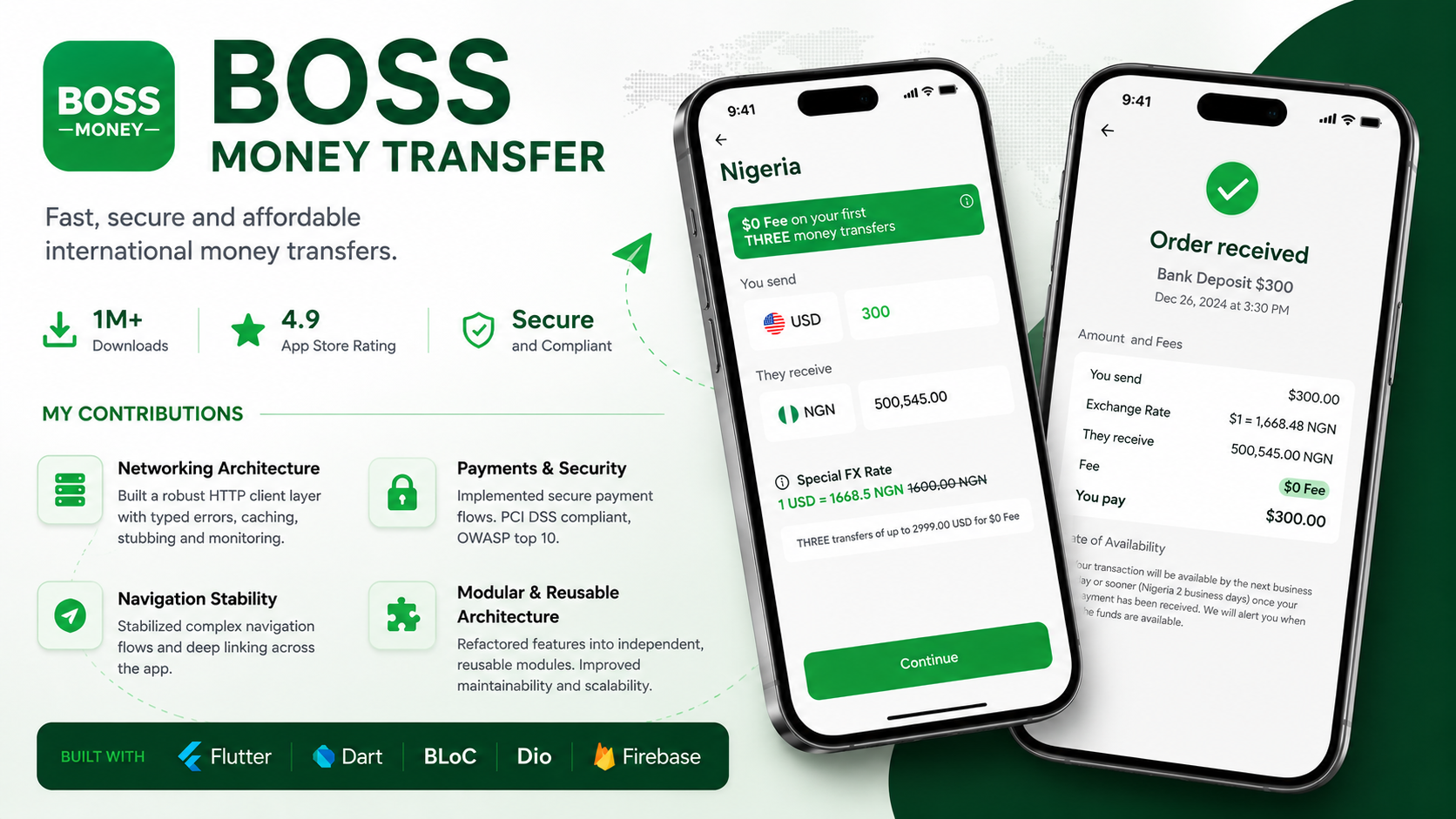
BOSS Money Transfer is an international money transfer application with more than 1 million downloads, enabling users to send money through multiple delivery methods including cash pickup, mobile wallets, bank deposits, home delivery, and direct debit.
I worked on the product as a Senior Software Developer, focusing on mobile architecture, payment functionality, application infrastructure, testing, observability, and developer experience.
My Role
As a Senior Software Developer, I contributed to architectural decisions and the development of core application capabilities, with a particular focus on maintainability, reliability, security, and developer experience.
My work included designing country-specific payment functionality, re-architecting the networking layer, improving navigation and analytics, increasing automated test coverage, integrating monitoring solutions, and developing internal tooling for developers and QA engineers.
I also mentored and onboarded new team members and contributed to technical decision-making across the project.
Key Contributions
Payment Capabilities
Designed and developed modules supporting country-specific payment methods and integrated third-party frameworks required for payment and money-transfer flows.
Networking Architecture
Re-architected the HTTP client layer to reduce code duplication and improve separation of concerns. Introduced request caching, typed error handling, request stubbing, and comprehensive unit test coverage for the networking layer.
Navigation
Improved the application's navigation and routing architecture to provide a more maintainable foundation for application flows.
Analytics & Observability
Improved analytics event tracking and data quality and integrated crash reporting and performance monitoring solutions to make application stability issues easier to detect, prioritize, and investigate.
Testing
Increased automated test coverage for critical application functionality using unit, integration, and Golden tests.
Developer & QA Tooling
Developed a configurable Debug Menu that allows developers and QA engineers to toggle feature flags, modify application configuration, and inspect network traffic at runtime.
Architecture & Networking
The networking layer was redesigned around clearer separation of responsibilities and reusable abstractions.
The new HTTP client architecture reduced duplicated networking logic and introduced typed error handling, request caching, testable request execution, and request stubbing for automated tests.
This made networking behavior easier to reason about, test, and evolve as new application functionality was introduced.
Quality & Security
Automated Testing
Expanded automated testing across critical application functionality using unit, integration, and Golden tests. The networking layer was designed to support request stubbing, enabling deterministic testing of network-dependent behavior.
Mobile Security
Developed secure payment and money-transfer functionality following PCI DSS requirements and OWASP Mobile security best practices.
Application Stability
Integrated crash reporting and performance monitoring capabilities to improve visibility into application stability and performance issues.
Developer Experience
Developer and QA productivity was treated as part of the product's engineering infrastructure.
I developed a configurable Debug Menu that provides runtime access to feature flags, application settings, and network traffic inspection, allowing developers and QA engineers to investigate and test application behavior without modifying production code paths.
I also contributed to onboarding and mentoring new team members and participated in architectural discussions and technical decision-making.
AI-Assisted Development
Developed and maintained project-specific AI agent configurations, custom rules, and reusable skills to support development workflows and standardize engineering practices.
The goal was to provide AI-assisted development tools with project-specific context and conventions instead of relying only on generic code-generation prompts.
Results
The work contributed to a more structured and maintainable engineering foundation for a production FinTech application with more than 1 million downloads.
Key outcomes included:
- Re-architected the HTTP client around clearer responsibilities, typed errors, caching, and testability.
- Delivered country-specific payment functionality and third-party payment integrations.
- Improved application navigation and analytics infrastructure.
- Expanded automated testing across critical application functionality.
- Strengthened payment and money-transfer functionality according to PCI DSS and OWASP Mobile security practices.
- Improved developer and QA workflows through runtime debugging and configuration tooling.
- Established reusable AI agent configurations, rules, and skills for project-specific development workflows.