CHR Mobile
Team Lead · Healthcare
Overview
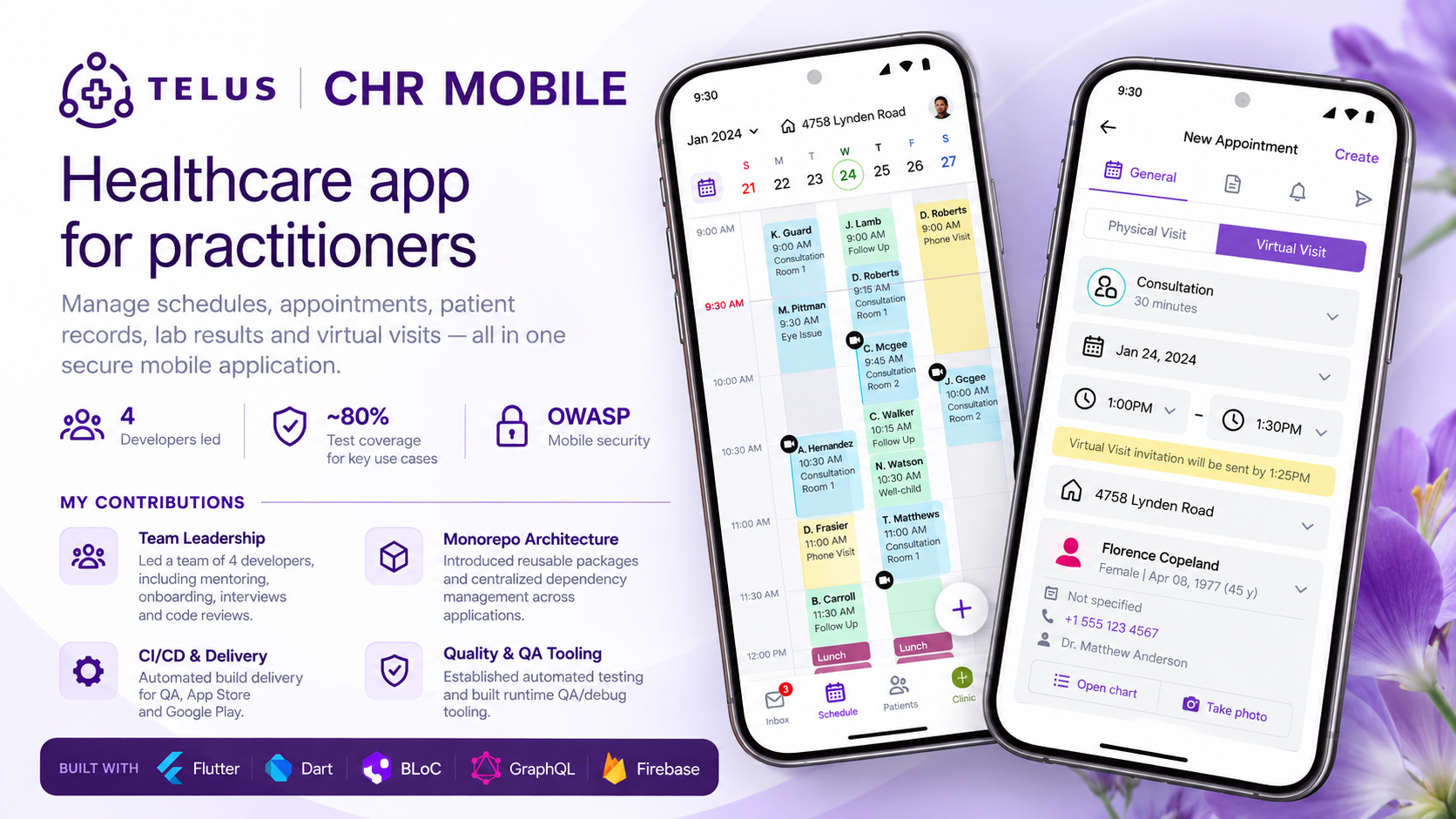
CHR Mobile is a healthcare application for practitioners within one of Canada's largest healthcare networks.
The application enables healthcare professionals to manage schedules and appointments, access patient records and laboratory results, conduct virtual visits, manage clinical communications, and securely capture and upload patient photos.
I worked on the project as Team Lead, leading a team of four developers and contributing to the product from MVP development through successful production delivery.
My Role
As Team Lead, I was responsible for both technical leadership and engineering delivery.
My responsibilities included architecture and technical decision-making, mentoring developers, conducting interviews and onboarding, code reviews, establishing engineering practices, improving automated testing, implementing CI/CD, maintaining project documentation, and collaborating with cross-functional teams.
Alongside leadership responsibilities, I remained actively involved in engineering and the development of the application's technical foundation.
Team Leadership
Leading the Engineering Team
Led a team of four developers, providing technical leadership, mentoring, onboarding, interviews, and code reviews.
Knowledge Sharing
Organized weekly technical sessions for the development team to share knowledge, align engineering approaches, reduce duplicated solutions, and maintain consistent development practices.
Cross-Functional Collaboration
Collaborated with other project disciplines on technical decisions and feature delivery, helping connect engineering decisions with product requirements.
Key Contributions
MVP to Production
Contributed to the development of the product MVP and its successful delivery as a release version.
Monorepo Architecture
Introduced a monorepo structure that allowed multiple projects and reusable packages to coexist within a single repository, simplifying code sharing, dependency management, and reuse across applications.
Engineering Documentation
Created project documentation covering code review requirements and application functionality controlled by feature availability and build versions.
CI/CD
Implemented continuous integration and deployment pipelines that automated application build delivery for testing and release to the App Store and Google Play.
Analytics & Stability
Integrated analytics and crash reporting capabilities to improve visibility into application usage and stability.
QA Tooling
Developed a Debug Menu that enabled QA engineers to manage features under development, configure application parameters, and inspect network logs.
Architecture
The project adopted a modular approach based on a monorepo, allowing shared packages and functionality to be reused across multiple applications and modules.
Flutter and Dart formed the primary application platform, with BLoC and Cubit used for state management, GraphQL for API communication, and GetIt for dependency management.
Reusable packages and centralized dependency management helped establish a shared engineering foundation across the codebase.
Quality & Testing
Automated testing was treated as a core part of the engineering process.
The team achieved approximately 80% test coverage for key use cases, including Golden Tests for generating snapshots of important application screens.
The testing stack included Mocktail, BlocTest, Widget Tests, and Golden Tests.
Developer & QA Experience
Engineering tooling was developed not only for developers but also for QA workflows.
A configurable Debug Menu allowed QA engineers to enable or disable features under development, modify application parameters, and inspect network logging directly from the application.
Project documentation and regular technical knowledge-sharing sessions were used to make engineering practices and application behavior easier to understand across the team.
Delivery & Security
Continuous Delivery
Implemented CI/CD pipelines to automate the delivery of application builds for testing and publishing through the App Store and Google Play.
Mobile Security
Implemented security requirements following OWASP Mobile security best practices and supported the product through successful external penetration testing.
Results
The project progressed from MVP development to a successfully delivered production release while establishing engineering practices designed to support continued product development.
Key outcomes included:
- Led a team of four developers through development and delivery.
- Successfully contributed to MVP development and production release.
- Introduced a monorepo architecture with reusable packages.
- Achieved approximately 80% test coverage for key use cases.
- Established automated CI/CD for testing and store delivery.
- Improved QA workflows through runtime feature configuration and network debugging tools.
- Established project documentation and regular technical knowledge-sharing practices.
- Supported successful external penetration testing through implementation of OWASP Mobile security requirements.